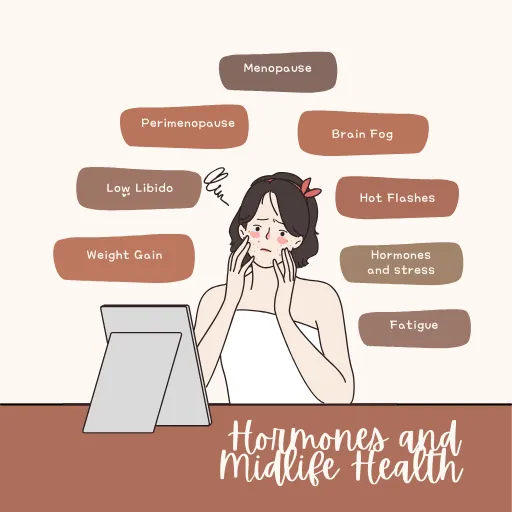
Is It Burnout, Perimenopause or Cortisol? How to Tell the Difference
Usually it's all three, and cortisol is the one pulling the strings. Burnout and perimenopause feel almost identical because they share a root: a stress response that's been running hot for years.
I hear the same story in my office every week. She's 42. She's running a business, a household, maybe a farm. She's exhausted by 2 p.m., wired at 10 p.m., up again at 3 a.m. Her jeans don't fit even though she's eating less. Her doctor ran labs. Everything came back normal.
She's not imagining it. And she's not just getting older.
How burnout, perimenopause and cortisol overlap
Symptom | Burnout | Perimenopause | Cortisol dysregulation |
|---|---|---|---|
Exhausted but can't sleep | Common | Common | Classic sign |
Waking at 2 to 4 a.m. | Sometimes | Common | Classic sign |
Belly weight that won't move | Sometimes | Common | Common |
Brain fog | Common | Common | Common |
Irritability, short fuse | Common | Common | Common |
Changing cycles, hot flashes | Common | Yes | Common |
Feels better on vacation | Yes | Not much | Often |
If most of your checks land in the cortisol column, start there.
Why cortisol comes first
Your adrenal glands make cortisol, and they also pick up hormone production as your ovaries slow down in perimenopause. If your stress response is already worn out from years of pushing, there's nothing left in the tank for that handoff. The symptoms hit harder and earlier.
I think of it like dominoes. Estrogen gets the blame, but in most women I test it's the seventh domino to fall, not the first. Cortisol, blood sugar and gut health usually go down before it.
That's why hormone replacement alone often doesn't fix it. It can help, and it's a valid choice to make with your medical provider. But if the upstream dominoes are still falling, you're patching the end of the line.
How to find out which one it is
Test the pattern, not a single number. A standard blood draw checks cortisol once, usually in the morning. A saliva test checks it four times across the day, so you can see whether yours is flat, backwards or spiking at night.
If your labs already came back normal, read Labs Normal but Still Exhausted? What Wasn't Tested for what a routine panel can miss.
The at-home kit I use also measures DHEA-S, secretory IgA (a marker of gut immune health) and insulin. Those four together usually tell me where the dominoes started.
What to do this week
Eat protein within an hour of waking. Get outside in the morning light for ten minutes, even in a Minnesota January. Stop the 9 p.m. scrolling and the second glass of wine for two weeks and notice your 3 a.m. wake-ups.
None of that replaces testing. But it's where I'd start if you were sitting across from me.
Want to know your pattern? Order the at-home saliva test kit or take the Start Here quiz.
Reviewed by Dr. Ashley Rath, functional health provider. This article is educational and isn't medical advice. Talk to your medical provider before changing medications.
